

Quick Summary
To spot fake band merchandise, check the seller and listing first, then inspect the neck tag, print quality, and stitching together. Fakes usually fail on several small details at once, such as odd tag fonts, blurry prints, and unusually low prices. Buying from the band's official store or a verified licensed partner is the safest option.
- Check the seller's review history, identity, and whether it traces back to the band's official channels.
- Inspect the neck tag for clean typography, licensing text, and a named manufacturer label.
- Judge print sharpness and color against official product photos taken in daylight.
- Treat a price far below official retail as a warning sign, combined with other clues.
- Save screenshots of the listing and seller profile before buying in case you need a refund.
Table of Contents
- Why Fake Band Merchandise Is So Hard to Spot
- Step 1: Check the Seller and the Online Listing
- Step 2: Inspect the Neck Tag and Label Typography
- Step 3: Judge Print Quality, Sharpness and Color
- Step 4: Examine Stitching, Fabric and Garment Construction
- Vintage Band T-Shirt Authentication: Dating Shirts Without Being Fooled
- How to Tell If a Band T-Shirt Is Official, and What to Do If You Bought a Fake
- Buying Official Merch With Confidence From Marvin Chambers Music
- Frequently Asked Questions
Why Fake Band Merchandise Is So Hard to Spot
Last Updated: October 30, 2026
Fake band merchandise is everywhere, and it often looks convincing at first glance.
Here is the core problem. Bootleggers copy the artwork, the tour dates and the logo, and they often copy the tags too.
Most fakes fail on small details. The neck tag might use the wrong font. The print might look blurry at the edges. The price might be too low to be real.
- Counterfeiters copy the design, not the production process
- Official sellers control tags, printing and licensing
- Cheap prices often signal cheap, unlicensed production
Step 1: Check the Seller and the Online Listing
Start with where you are buying. Most fake band merchandise is sold through listings that look official but are not, and the seller is often easier to verify than the shirt. This section gives you a repeatable seller-and-listing check that most authentication guides skip.
Verify the seller's history
- Account age and review pattern: A seller with no history, very few reviews, or a burst of reviews arriving at once is a warning sign. Look for reviews spread over time and tied to specific products.
- Review content, not just ratings: Read the reviews for mentions of print quality, tag details, or refund problems. Generic five-star reviews with no product specifics are weaker evidence than detailed ones.
- Seller identity: Check whether the seller name, storefront, and contact details are consistent across platforms. A store that changes names or has no verifiable business identity deserves caution.
Inspect the listing itself
- Product photos: Copied or stock photos, images taken from the band's official site, or photos that appear across multiple unrelated listings are red flags. Ask for a close-up, unfiltered photo of the tag and print in daylight.
- Listing language: Vague phrases like "official-looking," "bootleg-style," or "inspired by" are signals that the item is not licensed. A listing that says "official" is not proof of anything; check who runs the store and where the seller points you.
- Sizing charts and descriptions: Inconsistent sizing charts, mismatched descriptions, or details that do not match the product photos suggest a copied listing. Compare the description against the band's official product page.
Check authorized channels first
A band's own website or a verified, licensed merch partner is the safest place to buy. If you are unsure whether a seller is authorized, compare the seller against the band's official social accounts, which usually link to their store. When in doubt, buy from the official source and skip the authentication puzzle entirely.
Step 2: Inspect the Neck Tag and Label Typography
The neck tag is one of the fastest ways to test a shirt. Manufacturers print tags with consistent fonts, sizes and wording.
Look closely at:
- Font: Official tags use clean, even type. Fakes may use odd spacing or the wrong typeface.
- Licensing text: Look for copyright and licensing information. Missing or garbled text is a red flag.
- Manufacturer label: A real label names a maker and includes care and size details.
- Tag quality: Tags on genuine shirts are usually sewn in securely. Loose or glued tags deserve a second look.
Compare the tag with photos from the band's official store. If the wording differs, be cautious.
The neck tag is one of the fastest ways to test a shirt, and these are the checks to run on it.
| Check | What to look for | Red flag |
|---|---|---|
| Font | Clean, even type | Odd spacing or wrong typeface |
| Licensing text | Copyright and licensing information | Missing or garbled text |
| Manufacturer label | Maker name, care and size details | No maker named |
| Tag quality | Securely sewn in | Loose or glued tag |
Step 3: Judge Print Quality, Sharpness and Color
Print quality is where many fakes give themselves away. Hold the shirt in good light and look at the graphic from a few distances.
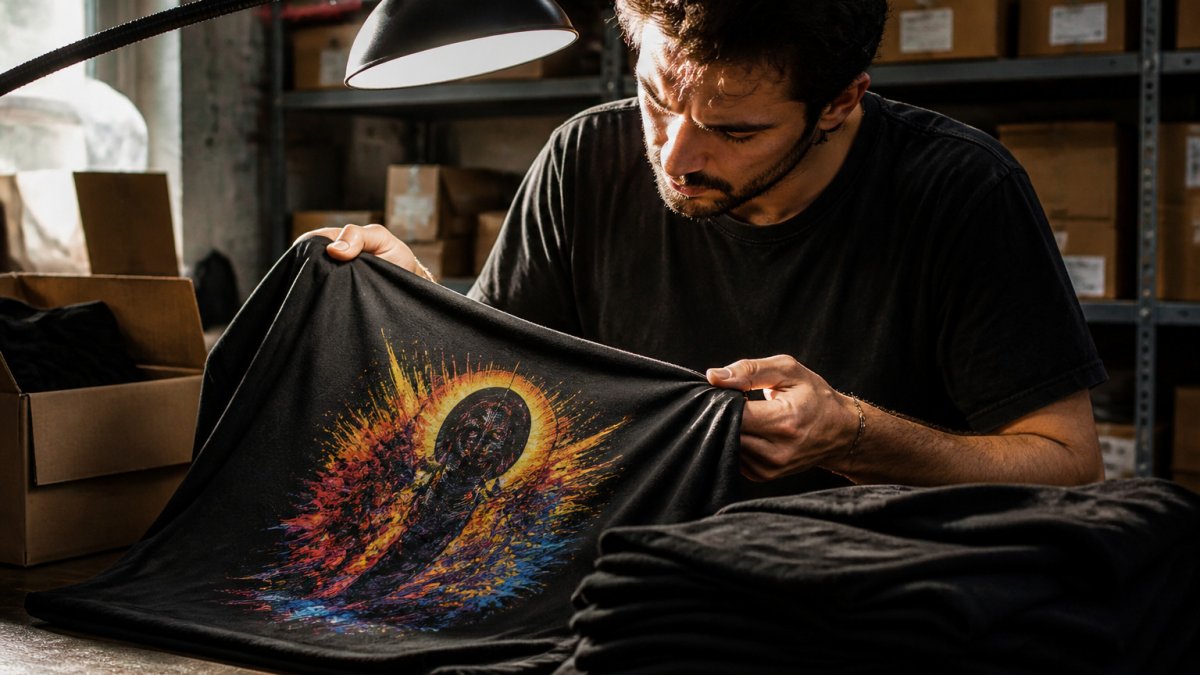
Check these points:
- Sharpness: Official prints have crisp edges. Fakes often look fuzzy, especially on small text.
- Color: Compare the colors with official photos. Off-color printing, like a dull red or a muddy black, suggests a counterfeit.
- Detail: Fine lines and small lettering should read clearly. Missing detail or smudged text is a warning sign.
A common mistake is judging a print only from a phone photo. Ask the seller for a close-up, unfiltered image in daylight.
Want an official option to compare against? The Marvin Chambers Music Logo - Performance Tee is a black unisex tee with a front graphic you can use as a reference.

Step 4: Examine Stitching, Fabric and Garment Construction
Construction details reveal a lot about how a shirt was made. Counterfeiters rarely invest in the same materials or sewing standards as licensed manufacturers.
Check these elements:
Marvin Chambers Music Logo - Performance Tee →
- Stitching: Look at the seams. Consistent, tight stitches suggest quality production. Loose threads or uneven seams often point to a fake.
- Fabric: Feel the cotton. Thin, scratchy or oddly stiff fabric can mean a cheap knockoff.
- Hems and sleeves: Official shirts have neat, even hems. Crooked or puckered edges are a warning sign.
Keep in mind that fabric varies by color and style, so compare with the same product from an official source.
Vintage Band T-Shirt Authentication: Dating Shirts Without Being Fooled
Vintage band tees follow different rules from modern merch, and this is where most authentication guides blur together. A shirt that looks old is not automatically genuine, because reprints and fakes imitate age on purpose. The stronger approach is to date the garment first, then judge the print and the seller against that date.
Start with the blank, not the graphic
Most vintage band shirts were printed on blanks from a handful of manufacturers, and those blanks changed over time. Collectors typically date a shirt by the blank's tag, the fabric content, and the construction before they look at the print. A common pattern is that a shirt claiming to be from a 1980s tour is printed on a blank that did not exist until the 1990s or 2000s.
Look at these blank-level clues:
- Tag design and wording: Tag shape, font, country of origin, and care instructions changed decade by decade. Compare the tag against documented examples from collector archives and tag-reference guides rather than guessing from memory.
- Fabric content: Early shirts were often 100% cotton or cotton-poly blends with a specific hand feel. A shirt labeled as vintage but made from a modern ring-spun blend deserves scrutiny.
- Construction details: Single-stitch versus double-stitch hems, sleeve seams, and collar construction are era clues. Note that reproductions can imitate single-stitch construction, so treat it as a clue, not proof.
- Print method: Older shirts often used plastisol or screen printing with a characteristic crackle and ink feel. Modern direct-to-garment or digital prints look different up close, even when distressed.
Separate vintage from reprint
A licensed reprint is not a counterfeit, but it is also not an original vintage shirt, and sellers sometimes blur the line. Ask directly whether the shirt is an original-era print or a later reprint, and check whether the listing uses words like "reprint," "reissue," or "modern reproduction." A reprint can be a legitimate purchase; the problem is paying original-vintage prices for one.
Judge artificial aging carefully
Distressing that looks too even, too uniform, or concentrated in the same spots across multiple listings is a warning sign. Genuine age tends to be uneven: collar wear, cuff fraying, and print cracking follow how the shirt was actually worn and washed. Compare the wear pattern with the garment's claimed age and with photos from collectors who own documented originals.
The modern-merch caveat
Vintage tag and stitching clues do not reliably apply to newer shirts. A 2020s official tour tee may use a modern tag, modern blank, and digital print, and none of that makes it fake. Separate your guidance by era: use blank-and-tag dating for pre-2000s pieces, and use seller verification, licensing text, and print quality for modern merch. Applying vintage rules to a new shirt produces false positives and can lead you to reject genuine merchandise.
How to Tell If a Band T-Shirt Is Official, and What to Do If You Bought a Fake
Putting the checks together gives you a clear answer. A shirt is more likely official when the seller is verified, the tag and licensing text are correct, the print is sharp and the construction is clean. It is more likely fake when several of those signs fail at once.
If you think you bought a fake, act quickly:
- Contact the seller and ask for a refund or return
- Use the platform's buyer protection process and document everything with photos
- Report the listing so others are not caught out
- Buy a verified replacement from an official source
Finding a trusted replacement matters. The Marvin Chambers Music Logo Unisex Tee Shirt is an official option from the brand's catalog.

Buying Official Merch With Confidence From Marvin Chambers Music
Buying directly from Marvin Chambers Music means you are buying from the brand's own catalog of official merchandise.
The Marvin Chambers Music Logo - Unisex Tee and the Marvin Chambers Music Logo - Organic Cotton Tee are two official options from the brand's catalog.

Keep the checklist from this guide handy. Check the seller, the tag, the print, the stitching and the price every time you shop.
Frequently Asked Questions
How can you tell if band merchandise is official?
Start with the seller: official merchandise comes from the artist's own store, a verified label store or an authorized retailer, and the listing should name the band's licensed merch partner or show clear contact details. Then check the garment itself: the neck tag should carry a manufacturer label and licensing or copyright information, the print should be sharp with clean edges, and the price should be in line with what the band's official store charges. A single weak signal is not proof, but several together usually settle the question.
How can you tell if a vintage band T-shirt is genuine or a bootleg?
Vintage authentication relies on period details. Look at the neck tag typography and the manufacturer label, check whether the stitching matches the era (single-stitch hems were common on older shirts, though not universal), and compare the graphic against documented tour dates for the year printed on the shirt. Reprints are common, so a shirt can be a genuine later pressing rather than a fake. Ask the seller for close-up photos of the tag and the hem before you buy.
What should I check on a band T-shirt tag?
Check that the tag typography is consistent and crisp, with no blurring or misspellings. Look for a manufacturer label, size information and, on modern official merch, copyright or licensing text. Compare the tag with photos of confirmed official shirts from the same band and era. Missing or unusually generic tags are a warning sign, but a tag alone never confirms authenticity, so combine it with the seller and print checks.
Are reprinted vintage band shirts considered fake?
Not necessarily. Many bands reissue classic designs through official channels, and those reprints are legitimate merchandise. The problem arises when a reprint is sold as an original from the year on the shirt. Check the tag and construction for the claimed decade, and if the listing says vintage, ask whether it is an original or a reissue before you pay.
