

Last Updated: November 2, 2026
Quick Summary
Open-toe shoes are not always safe at concerts, and the risk depends on crowd density, venue floor, and show energy. They work at seated shows or calm outdoor sets but fail in packed, dancing crowds where feet get stepped on. Choose closed-toe shoes for standing-room floors and pits.
- Sandals can work at seated concerts or relaxed outdoor shows, but not on packed general admission floors.
- Loose slides and flip-flops can slip off in a crowd surge and are gone for good.
- Match shoes to the ground: grass, dirt, gravel, and mud all favor closed-toe footwear.
- In a general admission pit or barricade area, closed-toe shoes are the safer default.
- Check the venue's prohibited items policy, since some venues require closed-toe shoes in pit or floor areas.
Table of Contents
- The Short Answer: Open-Toe Shoes at Concerts
- Can You Wear Sandals to a Concert? It Depends on the Crowd
- How to Protect Your Feet in a Concert Crowd
- The Best Shoes for Standing at a Concert
- What to Wear to an Outdoor Concert
- Safer Open-Toe Features and Venue Rules to Know
- Gear Up for the Front Row With Marvin Chambers Music
- Frequently Asked Questions
The Short Answer: Open-Toe Shoes at Concerts
Open-toe shoes are not always a safe choice at concerts.
Open-toe shoes work at a seated show or a calm outdoor set.
Open-toe shoes are any shoe that leaves part of the foot exposed, including sandals, slides, and flip-flops.
Below, we break down when open-toe shoes are safe, when they are not, and how to protect your feet either way.
Can You Wear Sandals to a Concert? It Depends on the Crowd
Sandals can work at a concert, but only when the crowd stays calm. A seated concert or relaxed outdoor show is fine; a packed general admission floor is not.
Think about three things before you slip on sandals:
- Crowd density: Can people move freely, or are they shoulder to shoulder?
- Venue floor: Is it flat, sloped, sticky, or littered with cups?
- Show energy: Will people jump, mosh, or dance hard?
If the crowd is dense and the show is loud and physical, closed-toe shoes win every time.
The Cleveland Clinic guide to foot safety notes that exposed feet are far more prone to cuts, stubbed toes, and impact injuries.
How to Protect Your Feet in a Concert Crowd
Protection starts before you leave the house. A few smart choices keep your feet safe and comfortable for hours.
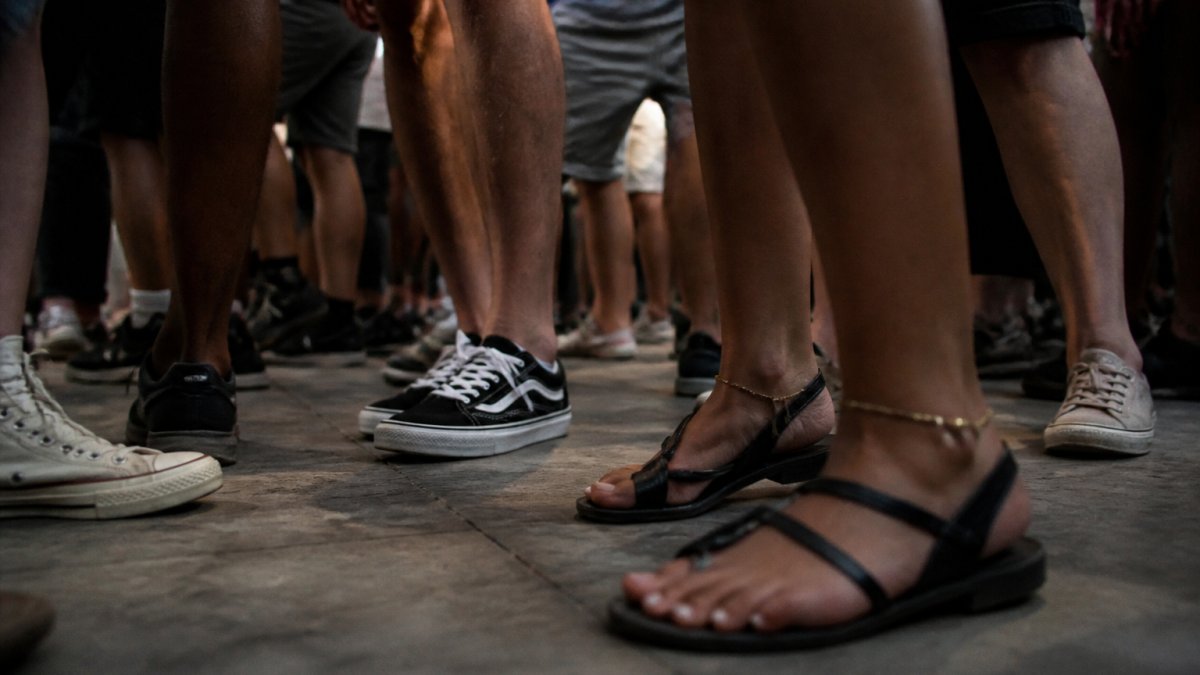
- Choose closed-toe shoes with a thick sole and secure straps or laces.
- Skip high heels and thin soles. They wobble on crowded, uneven floors.
- Wear supportive shoes with cushioning for long hours of standing.
Watch out: loose slides and flip-flops can slip off in a surge of people. Once a shoe is gone in a crowd, it is gone for good.
A secure fit matters more than style. Straps and laces keep your footwear attached when the floor gets chaotic.
The Best Shoes for Standing at a Concert
Here is what to look for:
- Cushioned sole for foot fatigue during long sets
- Secure fit with laces or straps
- Traction for sticky, wet, or uneven floors
If you want a closed-toe option that still looks sharp, our men's high top canvas shoes give you support and a bold look for the front row.
Those who want to keep it casual can browse our Softball - Men's Slides for the walk in and the after-hours.

| Shoe Type | Best For | Toe Protection | Standing Comfort |
|---|---|---|---|
| Sneakers | General admission, dancing | High | High |
| Canvas high-tops | Crowded floors, long sets | High | Medium to high |
| Slides | Seated shows, after-parties | Low | Medium |
| Flip-flops | Beach, chill outdoor sets | Very low | Low |
| High heels | Seated, short events | Low | Low |
What to Wear to an Outdoor Concert
Outdoor concerts add variables indoor venues do not: sun, rain, dust, grass, mud, and ground that shifts underfoot. The right footwear depends on surface, crowd density, and how long you will be on your feet.
Match your shoes to the ground, not just the sky
Outdoor venues range from paved amphitheater floors to grass lawns to dirt fields. Each surface changes the risk profile for open-toe shoes:
- Paved or concrete amphitheater floor. Similar to an indoor arena: the main risks are spilled drinks, dropped items, and crowd density. A strapped sandal with a rubber sole can work at a seated show; closed-toe is safer in a standing crowd.
- Grass lawn. Grass hides rocks, bottle caps, and uneven patches. Open-toe shoes expose toes to stubs and cuts that a closed toe would block. A thick sole helps, but a closed-toe sneaker or canvas shoe is the lower-risk choice, especially after rain.
- Dirt or gravel field. Loose ground shifts underfoot and gets into open shoes. Flip-flops and thin-soled sandals are a poor fit here; you want a closed toe and a sole with tread.
A useful rule: the rougher the ground, the more you should lean closed-toe, regardless of how calm the crowd is.
Build for heat, sun, and long days
Outdoor shows often mean arriving hours early, standing in queues, and walking from remote parking. Plan for the whole day, not just the set:
- Check the forecast for the full event window, including the walk back to the car at night when temperatures drop.
- Choose breathable, moisture-wicking fabrics for hot afternoons, and bring a light layer for the evening.
- Wear a hat and sunscreen if the venue has limited shade; sun exposure adds to foot swelling and fatigue.
Plan for rain and mud
Rain changes the footwear decision more than any other weather factor:
- A poncho is more useful than an umbrella at crowded outdoor shows, since umbrellas block views and are often banned.
- Closed-toe shoes you do not mind getting muddy are the practical choice when rain is likely. Canvas shoes dry out; leather and suede do not.
- Avoid open-toe shoes in mud. Mud pulls loose sandals off and hides debris that can cut exposed toes.
Outdoor crowd density matters as much as the weather
A seated lawn show with blankets and lawn chairs is a different event from a standing outdoor general-admission field. At a seated outdoor show, open-toe shoes with a thick sole and secure straps are reasonable. At a standing outdoor GA show, crowd density plus uneven ground makes closed-toe the safer default, even on a sunny day.
Outdoor shows reward preparation over style. Check the surface and crowd format first, the forecast second, and choose footwear that handles both.
Safer Open-Toe Features and Venue Rules to Know
Some open-toe shoes are meaningfully safer than others, and some venues decide the question for you before you ever leave the house. This section gives you a concrete checklist instead of a vague 'check the website' nudge.
What makes an open-toe shoe safer
Not all sandals are equal. The safer ones share a few mechanical traits:
- Wide, secure straps across the instep and ankle. A strap that crosses the top of the foot and wraps the ankle keeps the shoe attached when someone bumps you or the floor gets slick. A single toe-post flip-flop has nothing to hold it on during a lateral step.
- A thick, sturdy sole with a defined heel cup. A sole at least as thick as a typical sneaker midsole buffers sharp debris (bottle caps, broken glass, gravel) and keeps your foot from feeling every seam in the floor. A closed heel cup adds lateral stability so your foot does not roll off the footbed.
- Traction with a visible tread pattern. Smooth-bottomed sandals slide on spilled drinks and polished concrete. A rubber outsole with grooves grips better on sticky arena floors and wet grass.
People often buy sandals for looks and then discover the straps are decorative rather than load-bearing. Before a show, put the shoe on, step side to side and pivot quickly. If it shifts more than a centimeter on your foot, it will not survive a dense crowd.
Event-format risk tiers
The likelihood of being stepped on is not the same at every show. Use this tiering to decide before you buy a ticket or pack a bag:
- Seated, assigned seating (lowest risk). Rows are fixed, aisles are clear between sets, and neighbors stay in their seats. Open-toe shoes are generally fine here, though you still want a sole that handles a sticky floor and a walk from the parking lot.
- Seated, general-admission bleachers or lawn chairs (low to moderate risk). People move around more, and the ground may be grass, gravel, or uneven concrete. Open-toe shoes work if they have a thick sole and secure straps; flip-flops are a poor choice on gravel.
- Standing-room floor without a pit barrier (moderate to high risk). Shoulder-to-shoulder density means feet get stepped on during shifts in the crowd, even at calm shows. Closed-toe shoes are the safer default; if you wear open-toe, choose a strapped sandal with a closed heel and accept that your toes are exposed.
- General admission pit or barricade area (highest risk). Crowd surges, jumping, and pushing are common. This is closed-toe territory. No open-toe shoe design compensates for a crowd that cannot see the floor.
Venue rules checklist
Venue policies vary, and they are not always posted in an obvious place. Before the show, verify these specific points:
- Footwear restrictions. Search the venue's official website and the event page for 'prohibited items' or 'entry policy.' Some venues ban specific items (often citing safety), and a few require closed-toe shoes in pit or floor areas. Policies can change per event, so check the page for your specific date, not just the venue's general FAQ.
- Floor surface. Look at photos of the venue or search for recent attendee reports. Concrete, hardwood, artificial turf, and grass each change what sole you want.
- Bag policy. A clear-bag or small-bag rule affects whether you can carry a backup pair of flats or a bandage. If bags are restricted, plan your footwear around what you can carry on your feet.
- Weather policy. Outdoor venues may have rules about rain, mud, and what you can bring in (ponchos, umbrellas). A muddy field is a closed-toe situation regardless of crowd density.
- Entry and exit routes. Long walks from remote parking or transit stops add distance. A shoe that is fine for two hours of standing may not be fine for a mile walk each way.
OSHA guidance on foot protection explains in general terms how proper footwear reduces injury risk in active, crowded settings, the same logic applies to a concert floor where feet are stepped on and debris is present.
A common mistake is assuming your ticket type does not matter. It does. Seated fans can wear almost anything. Standing-room and pit crowds should default to closed-toe, and if you insist on open-toe, choose the strapped, thick-soled, closed-heel design and treat your toes as exposed.
Gear Up for the Front Row With Marvin Chambers Music
Your feet carry you through every set, every encore, and every walk back to the car. Treat them like it.
The safe move is simple: wear closed-toe, supportive shoes to crowded shows, and save the open-toe options for calm, seated events.
At Marvin Chambers Music, we build gear for fans who live for the music.
Ready to gear up? Explore the full collection and find your uniform for the next show.
Frequently Asked Questions
Are open-toe shoes safe to wear to a concert?
It depends on the setting. Open-toe shoes are generally fine for seated shows, VIP boxes, and relaxed outdoor venues where you have space. In a packed general-admission crowd, they expose your toes to being stepped on, spilled drinks, and dropped items. If the floor is standing-room only and tight, closed-toe shoes with a secure fit are the safer call.
Can you wear sandals to a concert?
Yes, with conditions. Sandals work well for seated concerts, outdoor festivals with grassy areas, and summer shows where comfort matters more than protection. Choose sandals with straps that hold your foot firmly, a sole with traction, and no loose dangling pieces that catch on stairs. Skip thin flip-flops for anything involving a dense standing crowd or long walking distance.
What shoes are best for standing at a concert?
Supportive sneakers with cushioned insoles and a closed toe are the most reliable choice for long hours on your feet. They handle foot fatigue, protect against being stepped on, and stay secure while dancing. Break them in before the show, wear moisture-wicking socks, and consider a lightweight pair you can walk in for the full trip home.
How can I protect my feet in a concert crowd?
Wear closed-toe shoes with traction, keep your stance wide to stay balanced, and avoid loose laces or dangling straps that can trip you. Stay aware of the space around you when the crowd surges, and keep breakable or heavy items out of open bags near your feet. If you wear open-toe shoes, choose secure straps and stay toward the edges of the floor rather than the pit.
Your next concert is coming. Will your feet be ready for it? Get started with Marvin Chambers Music and step into the crowd with gear built for the front row and the after-hours.
